

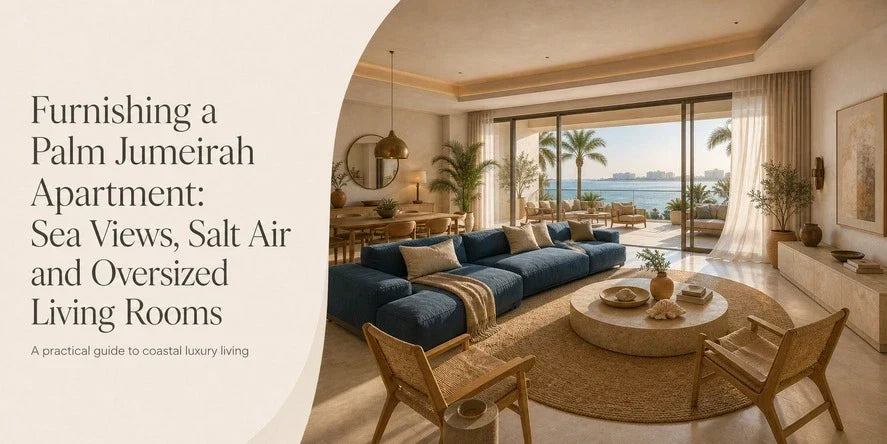
Furnishing an apartment on Palm Jumeirah is not the same job as furnishing a flat in Downtown Dubai or Business Bay. Salt-laden sea air, floor-to-ceiling windows facing the water, and living rooms built on a much larger scale all change what furniture actually works here. This guide breaks down exactly what to consider before you order a single piece, and where a ready-made, coastal-tested furniture package can save you from costly mistakes.
Why Palm Jumeirah Apartments Need a Different Furnishing Approach
Most furnishing advice for Dubai assumes a standard mid-rise apartment with average-sized rooms and no direct sea exposure. Palm Jumeirah breaks that assumption on three fronts at once: the building sits directly on the Gulf, so salt air reaches every room through balconies and ventilation; apartments are built with expansive glazing to showcase the water view; and living rooms in towers like Marina Residences, Oceana, or Azure Residences are noticeably larger than comparable units elsewhere in the city.
Ignore any one of these three factors and the result shows up fast — furniture that corrodes within a year, a beautiful view blocked by a badly placed sofa, or a living room that never quite feels finished because the furniture is scaled for a smaller apartment.
Dealing with Salt Air: Materials That Actually Last

Salt particles carried by sea air are corrosive, and they settle on every surface in a Palm Jumeirah apartment, not just the balcony. Over time, they degrade wood finishes, rust metal hardware, and weaken fabric fibers faster than in an apartment further inland. A sofa frame that would last for many years in JLT or Downtown can show real wear within a couple of seasons here if it wasn't built with coastal exposure in mind.
The fix isn't complicated, but it does mean being selective. Kiln-dried hardwood frames resist warping far better than particleboard or MDF, which break down quickly once humidity gets into the joints. Powder-coated aluminum or stainless steel hardware holds up where regular steel or chrome will rust. Performance fabrics such as solution-dyed acrylics or treated polyester blends resist moisture and won't develop mildew the way untreated natural fibers sometimes can indoors.
|
Furniture Element |
Choose |
Avoid |
|
Frame material |
Kiln-dried hardwood, solid wood |
Particleboard, untreated MDF |
|
Hardware and legs |
Powder-coated aluminum, stainless steel, brass |
Untreated steel, chrome |
|
Upholstery fabric |
Performance fabric, solution-dyed acrylic |
Untreated natural fibers indoors |
|
Wood finish |
Sealed, water-based lacquer |
Unsealed or raw wood finish |
Choosing a Color Palette That Complements the View
A sea view works best as the focal point of the room, which means the furniture around it should support the view rather than compete with it. Light, breathable palettes — soft whites, sandy beiges, muted blues, and sea-glass greens — tend to work naturally in a Palm Jumeirah living room because they echo the colors already visible through the window. A few deeper accent tones, like navy cushions or a warm terracotta throw, can anchor the space without overwhelming it.
Bright neons or heavy jewel tones tend to fight with a water view rather than complement it, so they're best used sparingly, if at all, in rooms facing the Gulf.
Furniture Placement for Panoramic Windows
Floor-to-ceiling windows are one of the biggest selling points of a Palm Jumeirah apartment, but they're also easy to furnish around badly. The most common mistake is placing a large sofa facing the window head-on, which blocks the view for anyone sitting elsewhere in the room. A better approach is to angle main seating so it points toward the view without sitting directly in front of it, letting the water remain visible from most seats in the room.
Keep tall furniture, like bookshelves or armoires, away from the window wall entirely. Coffee tables with glass tops or open bases let light and sightlines pass through rather than creating a visual block halfway across the room. Sheer curtains, rather than heavy drapes, are usually the better choice here, since they soften harsh afternoon sun without hiding the view residents are paying a premium for in the first place.
Furnishing Oversized Living Rooms Without Empty Space
Two-bedroom apartments on the Palm regularly run 1,500 to 2,200 square feet, and even one-bedroom units in buildings like Azure Residences or Oceana can exceed 1,100 square feet, which means living rooms are simply bigger than the citywide average. Standard furniture sets designed for a compact apartment often end up looking scattered and disconnected in a room this size.
The solution is to think in zones rather than a single furniture grouping. A large room can comfortably hold a main seating area facing the view, a secondary reading or lounge corner, and a distinct dining zone, each anchored by its own rug or lighting fixture. Oversized sectionals, sofas of 84 inches or longer, and substantial coffee tables read as proportionate in these rooms, where smaller furniture would simply get lost in the space.
Fabric and Texture Choices for Humid Coastal Interiors
Beyond resisting salt air, fabric choice affects how comfortable a Palm Jumeirah apartment feels day to day, given the year-round humidity typical of a Gulf-facing building. Linen and cotton blends breathe well and feel cooler against skin than heavier upholstery, which matters when air conditioning cycles on and off throughout the day. Natural woven textures — rattan, jute, cane, and seagrass — pair well with this climate both visually and practically, since they resist trapping moisture the way dense pile fabrics can.
Rugs made from jute or sisal in flat-weave styles are a safer choice than deep-pile wool in a coastal apartment, since they dry faster if any humidity or spills reach the floor and they fit naturally into the light, breezy palette that works best with a sea view.
Delivery Logistics in Palm Jumeirah Towers and Villas

Getting furniture into a Palm Jumeirah apartment is its own logistical challenge that rarely gets mentioned in general Dubai furnishing guides. Many towers on the Palm have service elevators with strict size limits, specific delivery time windows set by building management, and booking requirements that need to be arranged days in advance. Oversized sofas or dining tables that fit easily into a freight elevator in a newer Downtown tower can be a genuine problem if a Palm building's service lift is smaller or shared with other residents.
Villas on the Trunk or the Fronds have their own complications, including gated access approval, narrower internal doorways in older units, and stricter move-in scheduling through community management. Whoever handles your delivery needs to confirm elevator dimensions, loading dock access, and the building's approved delivery hours before a single item leaves the warehouse, not after a truck is already outside.
Budget Breakdown for Furnishing a Palm Jumeirah Apartment
Rents on Palm Jumeirah sit well above the Dubai average, and furnishing budgets tend to scale with the size and finish level of these apartments. A one-bedroom unit here typically rents for AED 140,000 to 240,000 a year, while two-bedroom apartments run AED 210,000 to 380,000, reflecting the larger layouts and premium buildings common across the Palm.
|
Apartment Type |
Typical Size (sq ft) |
Furnishing Budget (AED) |
|
Studio |
350 - 550 |
15,000 - 30,000 |
|
1 Bedroom |
1,100 - 1,700 |
35,000 - 65,000 |
|
2 Bedroom |
1,500 - 2,200 |
60,000 - 110,000 |
|
3+ Bedroom / Villa |
2,500+ |
100,000 - 250,000+ |
These ranges reflect furnishing a full apartment with coastal-appropriate materials rather than standard inland furniture, since salt-resistant frames, performance fabrics, and larger-scale pieces for oversized rooms typically sit slightly above generic citywide averages.
Maintaining Furniture in a Salt-Air Environment
Even the right materials need regular care near the water. Wiping down metal frames and hardware with fresh water removes salt deposits before they have a chance to cause corrosion, and this simple habit alone extends the life of balcony and living room furniture significantly. Wood pieces benefit from an occasional marine-grade sealant application, the same product used to protect boat decks, particularly on surfaces near open windows or balcony doors.
Fabric upholstery should be vacuumed regularly to prevent salt particles from settling into the weave, and any spills should be cleaned promptly since humidity slows natural drying time. None of this requires professional service on a regular basis, but skipping it for a year is usually when residents notice rust spots or fading that could have been avoided.
Ready-Made Styling Solutions for Coastal Palm Jumeirah Homes
Sourcing every piece individually — checking frame material, fabric type, and finish on each item — is realistic if you have weeks to spare and a clear design vision. Most people furnishing a Palm Jumeirah apartment don't, especially when balancing a move with work and the building's own delivery restrictions.
A curated, ready-made furniture package solves this in one step. Coastal-appropriate styles such as Sand, Marble, and Minimalism are built around the light palettes and durable materials this climate calls for, so there's no need to separately research salt-resistant hardware or performance fabric on every item. Delivery and assembly are included in the price, and orders can be coordinated in advance with a building's service elevator schedule, removing the single biggest logistical headache of furnishing on the Palm. For anyone who wants a coordinated, coastal-ready living room without months of individual sourcing, a pre-styled package delivered and assembled on-site is simply the faster, safer route.
Frequently Asked Questions
Does salt air actually damage furniture on Palm Jumeirah?
Yes. Salt particles carried through balconies and ventilation corrode untreated metal hardware and weaken wood finishes faster than in inland Dubai apartments, which is why coastal-rated materials matter here.
What furniture materials work best for a sea-view apartment?
Kiln-dried hardwood frames, powder-coated aluminum or stainless steel hardware, and performance fabrics like solution-dyed acrylics hold up best against humidity and salt exposure.
How much does it cost to furnish a Palm Jumeirah apartment?
A one-bedroom apartment typically costs AED 35,000 to 65,000 to furnish, while a two-bedroom unit runs AED 60,000 to 110,000, reflecting the larger room sizes common across the Palm.
Why is furniture delivery harder on Palm Jumeirah than elsewhere in Dubai?
Many towers have smaller service elevators, strict delivery time windows, and booking requirements set by building management, so oversized pieces need to be confirmed against elevator dimensions before delivery.
Can I use a ready-made furniture package instead of sourcing pieces individually?
Yes. Coastal-appropriate styled packages come with salt-resistant materials already selected, and delivery plus assembly can be coordinated around a building's service elevator schedule in advance.
اترك تعليقًا
This site is protected by hCaptcha and the hCaptcha Privacy Policy and Terms of Service apply.