

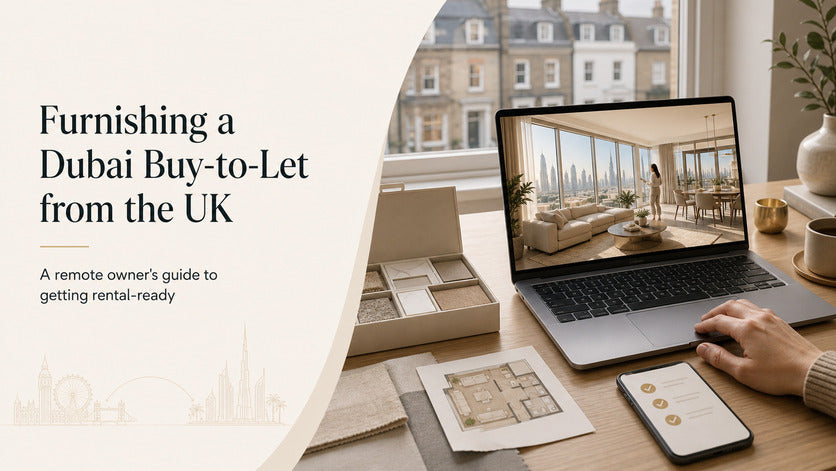
Owning an investment property in Dubai does not mean you need to fly over every time a sofa is delivered. A Dubai buy-to-let can be measured, furnished, installed and prepared for tenants while you remain in the UK. The key is to treat furnishing as a managed project rather than a series of unrelated online purchases.
A reliable remote process should give you control over the budget, specification and final result without requiring you to manage local deliveries from another time zone. You approve the plan and key decisions; a Dubai-based team handles access, measurements, installation and quality checks.
This guide explains how to furnish a Dubai apartment remotely, what to budget for and how to avoid the mistakes that delay rental income.
The Short Answer: Can It All Be Done Remotely?
Yes. You do not normally need to be in Dubai simply to select furniture, approve a quotation or arrange delivery. Your furnishing company will, however, need authorised access to the apartment. This may be arranged through the developer, building management, your estate agent, a property manager or another trusted local contact.
A well-managed service should provide:
-
A local survey and accurate room measurements
-
An itemised furniture proposal with clear inclusions
-
Digital approval of colours, sizes and any substitutions
-
Coordinated delivery, assembly and placement
-
Photos or a video walkthrough for final approval
-
An inventory, invoices and warranty information
Should You Furnish Your Dubai Buy-to-Let?

Furnishing is a commercial decision, not an automatic requirement for every landlord. A furnished studio or one-bedroom apartment in a central, business or tourist-led location may appeal to newly arrived professionals, corporate tenants and renters who value a quick move. Larger family homes may attract longer tenancies when offered unfurnished because tenants often want to bring their own belongings.
Start with comparable properties in the same building. Compare furnished and unfurnished asking rents, how long listings remain available and the quality of the competing interiors. An expensive package will not create a useful rent premium if local tenants prefer unfurnished homes. Equally, a poorly furnished property can perform worse than an empty but well-presented apartment.
|
Rental strategy |
Furnishing approach |
Main priority |
|
Long-term furnished |
Complete but restrained |
Durability, storage and broad appeal |
|
Corporate or medium-term |
Fully move-in ready |
Comfort, workspace and convenience |
|
Holiday home |
Furnished and equipped |
Compliance, guest experience and easy replacement |
|
Long-term unfurnished |
Minimal landlord-supplied items |
Low maintenance and tenant flexibility |
The safest rule is to furnish for a defined tenant, not for your own taste.
Work Out the Return Before Choosing a Style
The relevant question is not whether a furnished apartment can command more rent. It is whether the additional net income justifies the complete cost of making and keeping the property rental-ready.
Include the furniture, delivery, assembly, curtains, appliances, kitchen equipment, styling, photography and an allowance for future damage or replacement. Then compare the realistic annual income with that of a similar unfurnished unit. Use achieved rents where possible rather than the most optimistic advertised figures.
A simple calculation is:
Payback period = total furnishing cost ÷ annual net rental uplift
For example, if the complete setup costs AED 24,000 and the furnished property produces AED 12,000 more net income per year after additional costs, the estimated payback period is two years. Your building, unit size, lease type, vacancy and management arrangement can change the result significantly.
Remember that furniture has a useful life. A higher-quality mattress, sofa frame or dining chair may cost more initially but can be cheaper than replacing a weak item after every tenancy.
How Much Should You Budget?
There is no single cost to furnish a Dubai buy-to-let. A core package may cover the main bedroom, living and dining furniture, while a genuinely turnkey property may also need curtains, appliances, linen, kitchenware, lighting and accessories.
As a current starting reference, FullFlat packages begin at approximately the following levels. Prices and package contents can change, so the live collection pages should always be checked before setting a final budget.
|
Property type |
Current core-package starting point |
Budget separately for |
|
Studio |
About AED 7,300 |
Appliances, curtains and home essentials |
|
One bedroom |
About AED 12,600 |
Kitchenware, linen and finishing touches |
|
Two bedrooms |
About AED 16,800 |
Second-bedroom specification and extra equipment |
You can compare the full range of Dubai furniture packages, including different styles and price levels. For a more relevant comparison, browse the dedicated one-bedroom furniture packages or two-bedroom furniture packages.
Ask for an itemised quotation. “Fully furnished” means different things to different providers, and a low initial figure may exclude the items that make the apartment genuinely ready to let.
Long-Term Rental and Holiday Home Requirements Are Different

A long-term tenant generally needs comfortable furniture, sensible storage, effective curtains and a functional dining or work area. Décor should photograph well but remain neutral enough to suit different people. Easy-clean materials and standard-sized pieces simplify maintenance between tenancies.
A holiday home needs a more complete specification. Guests expect cookware, crockery, linen, towels, small appliances and practical information as well as furniture. The property may also experience more frequent cleaning and higher turnover, so replacement speed matters as much as appearance.
Dubai’s Department of Economy and Tourism states that apartments and villas must be registered and approved before they are listed as holiday homes. Furnishing alone does not provide permission to operate. Owners should check the current DET holiday-home permit requirements and confirm building-specific rules with their operator or property manager.
For either rental model, prepare a signed furniture inventory and photographic condition report. Record quantities, existing marks, appliance serial numbers and the location of keys or remote controls. This creates a clear reference at tenant check-in and check-out.
A Step-by-Step Remote Furnishing Process
Remote furnishing works best when every stage has a clear owner, approval point and record. The following sequence keeps the project moving without removing your control.
-
Define the rental brief. Confirm whether the property will be a long-term rental, corporate let or holiday home. Set the target tenant, budget, required completion date and desired level of furnishing before selecting products.
-
Arrange local access. Tell the developer, agent or building management who may collect keys and enter the apartment. Ask whether a delivery booking, move-in permit, refundable deposit or service-lift reservation is required.
-
Complete a survey. A local team should measure rooms, windows, doors and access routes. It should also check sockets, TV points, built-in storage and any defects that could affect installation. Developer floor plans are helpful, but small site differences can make a sofa or dining table unsuitable.
-
Approve an itemised specification. Review product names, dimensions, quantities, colours and room placement. The quotation should show what is excluded and what happens if an item is unavailable. Agree acceptable substitutions in writing rather than during delivery.
-
Confirm commercial terms. Check whether the price includes VAT, delivery, assembly, installation, packaging removal and cleaning. Review the payment schedule, warranty, cancellation terms and responsibility for damage to the apartment or common areas.
-
Coordinate delivery and installation. One coordinated installation is usually easier to control than several deliveries from unrelated retailers. The local team should inspect items on arrival, assemble them, place them according to the approved plan and remove packaging.
-
Carry out remote quality control. Request wide-angle photos of every room, close-ups of finishes and a live video walkthrough. Test drawers, doors, lights and appliances. Log incomplete or damaged items in a snagging report with an agreed correction date.
-
Create the handover file. Keep the final inventory, paid invoices, warranties, product care instructions, supplier contacts and dated photographs together. Give the relevant documents to your property manager while retaining your own digital copy in the UK.
-
Prepare the listing. Professional photographs should be taken only after snagging, styling and cleaning are complete. The listing description and inventory must accurately reflect what the tenant or guest will receive.
What Every Room Needs
The right contents depend on the tenant and lease type, but most furnished buy-to-let apartments need a consistent functional base.
|
Area |
Rental essentials |
Useful upgrades |
|
Living room |
Sofa, coffee table, TV unit, curtains |
Rug, side table, floor lamp and artwork |
|
Bedroom |
Bed, quality mattress, bedside tables, blackout curtains |
Mattress protector, lamps and additional storage |
|
Dining/work area |
Table, easy-clean chairs and accessible power |
Compact desk and ergonomic chair |
|
Kitchen |
Major appliances agreed in the inventory |
Cookware, crockery and small appliances |
|
Entrance/balcony |
Lighting and safe circulation |
Mirror, shoe storage and weather-suitable outdoor seating |
Avoid filling every empty corner. Over-furnishing makes rooms look smaller, creates more items to maintain and can restrict movement. Good furnishing improves the layout rather than hiding it.
Choose Materials for Rental Life in Dubai
Rental furniture has to survive regular use, cleaning and strong daylight. Prioritise sturdy frames, stable tables, washable or replaceable covers and finishes that are easy to repair. Standard mattress and linen sizes make replacements faster. Neutral main pieces can be refreshed with lower-cost cushions, artwork and accessories when the apartment is re-marketed.
Spend more on items that affect comfort and receive daily use, especially the mattress, sofa and dining chairs. Save on decorative objects that are easier to damage or lose. If an unusual item has a long replacement lead time, ask whether a comparable product will remain available later.
Common Mistakes Made by Overseas Landlords
The most expensive remote furnishing problems usually come from coordination rather than design. They include ordering before the apartment is measured, assuming appliances or curtains are included, ignoring delivery restrictions and approving products without dimensions.
Other avoidable mistakes are:
-
Choosing furniture for personal taste instead of the target tenant
-
Accepting a quotation without a complete item list
-
Allowing substitutions without written approval
-
Paying the final balance without photographic inspection
-
Skipping the inventory and condition report
-
Forgetting warranties and local aftercare
A single accountable provider can reduce these risks, but the scope and approval process must still be clear.
What to Ask a Dubai Furnishing Company
Before placing an order from the UK, ask who will take measurements, manage access and supervise installation. Confirm the expected timeline, stock position and procedure for delayed or damaged items. You should also know whether the company provides room placement, packaging removal, final cleaning, a video walkthrough and aftercare.
Be cautious if the proposal has no dimensions, uses only generic inspiration images or describes the result as turnkey without defining the term. A professional supplier should be comfortable giving you an itemised scope and explaining exactly what will be ready at handover.
A Brief UK Tax Note
Remote furnishing does not change your tax residence. If you remain UK tax resident and receive rent from a Dubai property, you may need to report overseas property income in the UK. The treatment depends on your circumstances, ownership structure and any available relief, so retain invoices and payment records and consult a qualified adviser. Current guidance is available in the HMRC Property Income Manual.
Do not assume every furniture purchase is immediately deductible. Tax treatment can differ between initial capital expenditure, replacements and repairs.
Make the Apartment Rental-Ready with FullFlat
FullFlat offers coordinated furniture packages for Dubai apartments, including solutions for long-term rentals and holiday homes. Instead of buying room by room from different suppliers, you can select a prepared collection, confirm the details remotely and arrange local delivery, assembly, placement and packaging removal.
For a UK landlord, this creates one clear route from an empty apartment to a furnished property. Send the apartment type, floor plan, building name, rental strategy, budget and handover date to receive a more accurate recommendation. Once access is arranged, the Dubai team can handle the physical work while you review progress and approve the result remotely.
The goal is simple: a durable, attractive apartment that is ready to photograph, market and rent without an unnecessary flight from the UK.
Frequently Asked Questions
These answers cover the practical questions UK-based owners ask most often.
Do I need a power of attorney to furnish my Dubai apartment?
Not usually for selecting and installing furniture. You must still authorise access through the appropriate developer, agent or building management process. A power of attorney may be required for separate legal or property-management actions, so confirm this with the organisation handling them.
How long does it take to furnish a Dubai apartment remotely?
Timing depends on stock, customisation, access and building delivery rules. A prepared in-stock package can be installed much faster than a bespoke interior. FullFlat’s current average journey from order to ready apartment is approximately seven days, but your written quotation should confirm the project-specific date.
Are appliances and curtains included in a furniture package?
They may be included, excluded or offered as add-ons. Never rely on the package name alone. Check the itemised specification for appliances, curtains, lighting, linen, kitchenware, décor, delivery, assembly and cleaning.
How can I inspect the apartment from the UK?
Request dated photographs, a live video walkthrough and a written snagging report. The final handover file should also contain an inventory, invoices, warranties and photographs showing the condition of every room.


Оставить комментарий
Этот веб-сайт защищается hCaptcha. Применяются Политика конфиденциальности и Условия использования hCaptcha.