

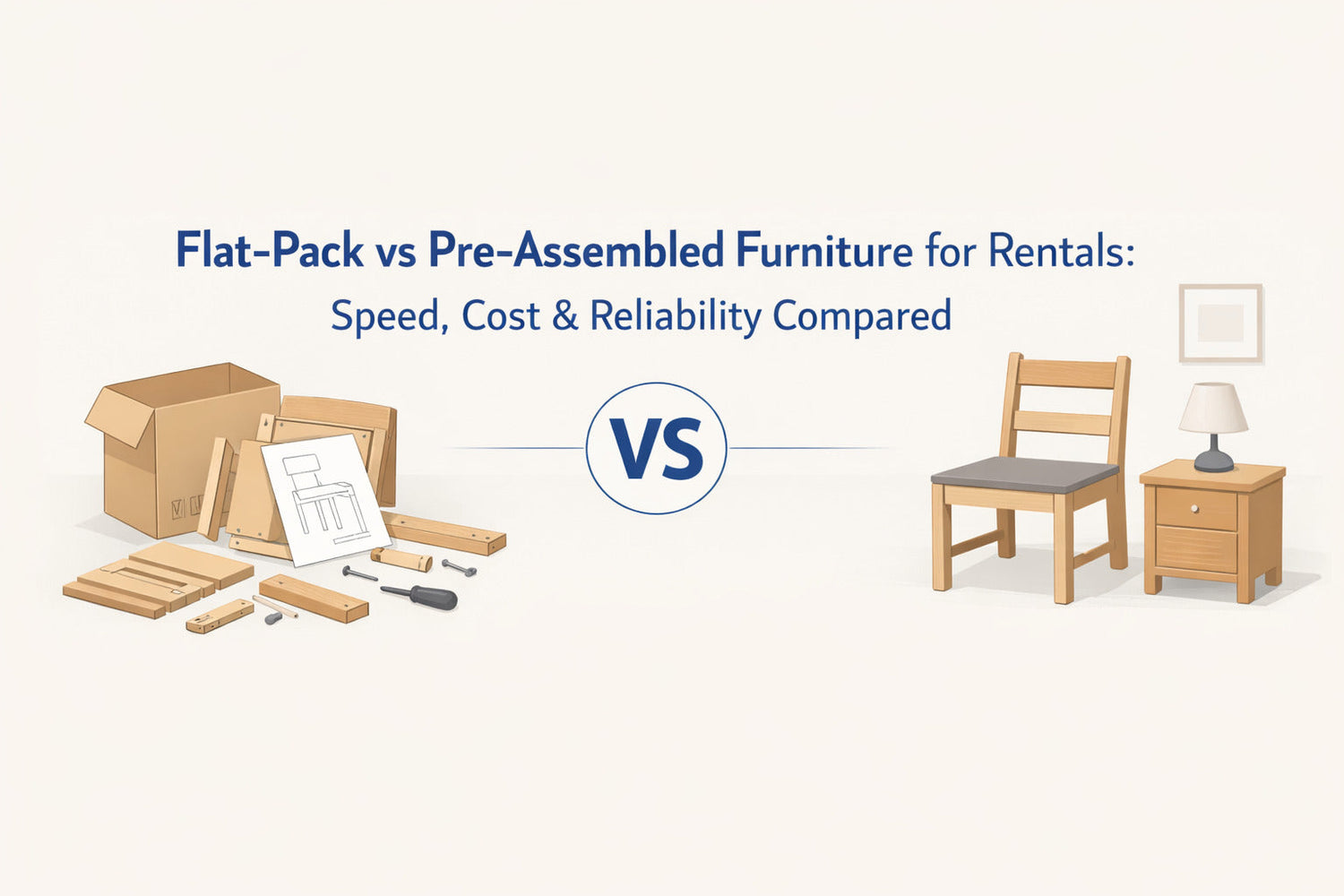
Rentals come with a different kind of pressure than a “forever home.” You often need furniture that works fast, fits into tight spaces, and survives moves or tenant turnover without becoming wobbly, scratched, or unfixable. That’s why the flat-pack vs pre-assembled decision isn’t just about style or brand. It’s about speed, total cost, and reliability.
This guide compares both options specifically for rentals, with practical checklists, a simple “real cost” framework, and a scorecard you can use to decide in minutes.
Introduction: The Rental Reality (Fast Move-In, Tight Access, Frequent Changes)
In a rental, the timeline is often compressed. Renters may need to be “move-in ready” in a weekend. Landlords and hosts may need to furnish a unit between tenants quickly to avoid vacancy days. At the same time, rentals frequently have tricky constraints: narrow staircases, small elevators, strict delivery windows, and building rules about noise or work hours.
Furniture also takes more abuse in rental life. Pieces may be moved more often, rearranged to fit different layouts, or handled by delivery crews and movers multiple times. That’s why the best choice is the one that balances how fast you can set up, how much it truly costs, and how well it holds up.
Quick Pick: Choose Flat-Pack or Pre-Assembled in 60 Seconds

If you want the fastest decision, use these rules of thumb.
Choose flat-pack (RTA) if:
-
Your building has tight access (stairs, narrow halls, small elevator).
-
You may move again within 12–24 months.
-
You want a lower upfront price and you’re okay assembling (or hiring help).
-
You need modular pieces that can be carried in parts and reconfigured.
Choose pre-assembled if:
-
You want minimal setup time and fewer assembly mistakes.
-
You value stability and durability more than portability.
-
Your building access is easy (wide doors, elevator, ground-floor entry).
-
You’re furnishing a long-term rental and want fewer maintenance headaches.
If you’re stuck between the two, a hybrid approach is common in rentals: buy flat-pack for access-friendly items and add professional assembly so you get speed without DIY stress.
Definitions (In a Rental Context)
Flat-pack furniture (also called RTA: ready-to-assemble) arrives in boxes with panels, hardware, and instructions. You assemble it inside the unit. For rentals, the big advantage is access: boxes fit through tight spaces. The big tradeoff is time and the risk of assembly issues.
Pre-assembled furniture arrives fully built or mostly built. For rentals, it can be faster to live with immediately and often feels sturdier. The tradeoff is delivery risk: large items can be hard (or impossible) to bring into some buildings, and shipping can cost more due to size and handling.
Neither is “always better.” The right choice depends on how quickly you need it, how your building works, and what happens when you move or when tenants change.
Speed: How Fast You Can Get Move-In Ready
Speed is more than “how long assembly takes.” In rentals, speed includes everything from delivery to having a functional room.
Flat-pack speed reality: Flat-pack can be quick if the item is simple and the instructions are clear. But many renters underestimate the full timeline: unboxing, sorting hardware, building, tightening, cleanup, and dealing with missing pieces. If something is wrong, you may lose days waiting for replacements.
Pre-assembled speed reality: Pre-assembled can be almost instant once it’s inside the unit. The time risk is at the front of the process: delivery scheduling, elevator reservations, navigating hallways, and potential failure to fit through doors. If it doesn’t fit, you can lose the entire delivery slot and still have no furniture.
A practical way to think about speed is the “move-in readiness timeline”:
|
Step |
Flat-Pack (RTA) |
Pre-Assembled |
|
Delivery and carrying inside |
Usually easier (boxes) |
Can be difficult (bulky) |
|
Setup inside the unit |
Takes time (assembly) |
Fast (minimal setup) |
|
Risk of delays |
Missing parts, misassembly, fatigue |
Access problems, rescheduling |
|
Cleanup |
More packaging |
Less packaging |
In a typical rental move-in, the fastest setup is often the one with fewer surprises. If your building access is uncertain, flat-pack frequently wins on speed because it’s predictable. If your access is easy and you’re short on time, pre-assembled can win because you can use it immediately.
Cost: Upfront Price vs Real Rental Costs (Simple TCO)
Many comparisons stop at the price tag. Rentals shouldn’t. You need the “real cost,” which includes delivery, time, assembly, and how many times you’ll pay again through repairs or replacements.
A simple way to do this is a light version of TCO (Total Cost of Ownership). You don’t need spreadsheets. You just need to remember what the price tag hides.
Cost Breakdown Checklist (What to Include)
Use this checklist when comparing two similar pieces:
-
Item price (what you pay today)
-
Delivery fees (including bulky-item or room-of-choice delivery)
-
Assembly cost (your time or a paid pro)
-
Tools and supplies (basic tools, wall anchors, felt pads)
-
Risk costs (mistakes, damage, missing hardware, returns)
-
Move-related costs (disassembly, reassembly, transport protection)
-
Replacement likelihood (how often the piece is likely to be swapped)
Flat-pack often looks cheaper upfront, but becomes less cheap if you value your time highly or if the item is complicated. Pre-assembled often costs more upfront, but can reduce “hidden costs” like assembly frustration, returns due to build errors, or wobble after imperfect assembly.
Simple TCO Formula for Renters & Hosts
Here’s a simple formula you can apply to one item:
Real Cost = Item Price + Delivery + Assembly + Expected Fix/Replace Cost – Expected Resale Value
How do you estimate “Expected Fix/Replace Cost” without guessing wildly? Use your rental context:
-
If you move frequently, add more risk to flat-pack joints loosening or panels chipping during transport.
-
If your building access is tight, add more risk to pre-assembled delivery damage or delivery failure.
-
If you manage a property, add more risk to tenant turnover and higher daily wear.
For landlords and hosts, there’s one extra cost that matters: vacancy time. If pre-assembled delivery delays your setup by even a few days, those days can cost more than the price difference. For renters, the “cost” may be living without a bed frame or table for a week, which is a real quality-of-life hit.
Reliability: Stability, Safety & Durability in Rentals
Reliability is where rentals can punish the wrong choice. A piece that feels fine on day one can become unstable after a move, or after repeated tightening and loosening of screws.
Flat-pack reliability: Flat-pack relies heavily on connection points. When assembled perfectly, many items are stable and long-lasting. But if alignment is slightly off, fasteners are overtightened, or the floor is uneven, you can get wobble. Over time, repeated tightening can wear down particleboard holes or weaken cam locks. In rentals, this shows up as “it’s fine until it isn’t.”
Pre-assembled reliability: Pre-assembled pieces often feel sturdier because they were built in a controlled process and may use stronger joinery. That can mean fewer wobbly chairs, more stable frames, and less need for ongoing tightening. The weak spot is transport. If a bulky piece is bumped on stairs or forced through a doorway, joints and legs can take stress.
Reliability in rentals is also about safety. A shaky wardrobe, a leaning bookshelf, or a bed frame that creaks under load becomes a problem faster in shared living spaces. If children are present, or if the furniture is tall, you should plan for proper anchoring regardless of flat-pack or pre-assembled.
Delivery & Access Risk: Doors, Stairs, Elevators

In rentals, access is often the deciding factor that people discover too late. Pre-assembled furniture can be fantastic, but it’s only fantastic if it actually reaches the room.
5-Minute Access Checklist (Measure Before You Order)
Before buying, measure these once and save them in your notes:
-
Doorway width and height (unit door and building entrance)
-
Hallway width and any sharp turns
-
Staircase width and ceiling clearance on landings
-
Elevator interior dimensions and door opening size
-
The room space where assembly will happen (for flat-pack)
A common mistake is measuring only the unit door and ignoring the building turns, the stairwell, or the elevator opening. Another mistake is forgetting that flat-pack assembly also needs space. If a room is very small, you may need to assemble vertically or in stages.
If your access is borderline, flat-pack lowers the risk because boxes are smaller and easier to angle. If access is generous, pre-assembled becomes more attractive because the delivery step is simpler.
Best Choice by Scenario (Renter vs Landlord/Host)
Different rental situations push the decision in different directions. Here are the most common ones.
If you’re a renter moving often: Flat-pack often makes sense because it’s portable. But focus on reliability: choose pieces that are designed to be disassembled, avoid ultra-cheap fasteners, and be realistic about how many times you want to rebuild a complex item. For a frequently moving renter, it can be smart to combine flat-pack for storage and tables with a more robust pre-assembled sofa or mattress setup, as long as access allows it.
If you’re furnishing a unit as a landlord or property manager: The goal is fewer issues, faster turnovers, and lower maintenance. Pre-assembled pieces can reduce assembly-related damage and speed up the unit’s readiness, but only if delivery is reliable. Flat-pack can work very well if you standardize a set of items and use professional assembly so the result is consistent and stable across units.
If you run a short-term rental or furnished rental: Turnover speed and appearance matter. You want pieces that are easy to clean, stable for many different users, and quick to replace if damaged. In this scenario, reliability and replaceability can matter more than the lowest initial price. Flat-pack can be convenient because it’s replaceable and accessible, while pre-assembled can feel more premium and reduce setup time if your building access is easy.
Hybrid Option: Flat-Pack + Pro Assembly (When It’s Worth It)
The hybrid approach is popular because it targets the three core priorities at once.
-
Flat-pack helps with access and often lowers item cost.
-
Professional assembly improves speed and reduces mistakes.
-
A consistent build quality improves reliability.
Hiring assembly is usually worth it when the item is complex (large wardrobes, bed frames with storage, multi-door cabinets) or when speed matters (move-in weekend, tenant turnover, staging). It can also be worth it if you’ve had bad experiences with missing hardware, unclear instructions, or uneven floors where correct leveling matters.
For pre-assembled furniture, the “hybrid” version is usually upgraded delivery: room-of-choice delivery or white-glove delivery, especially in buildings with booking rules. It costs more, but it can prevent damage and reduce the risk of failed delivery.
Comparison Scorecard (Speed vs Cost vs Reliability)
This scorecard summarizes the typical outcome for rentals. Your results may differ by product quality and building layout, but the pattern is consistent.
|
Category |
Flat-Pack (RTA) |
Pre-Assembled |
|
Speed to get inside the unit |
Usually faster |
Can be slow if access is tight |
|
Speed to use the item |
Slower (assembly needed) |
Faster (ready-to-use) |
|
Upfront cost |
Often lower |
Often higher |
|
Real cost risk (hidden costs) |
Time, mistakes, missing parts |
Delivery fees, access failure |
|
Reliability over multiple moves |
Mixed (depends on design) |
Often stronger, but bulky to move |
|
Best fit for tight buildings |
Strong advantage |
High risk |
|
Best fit for long-term stability |
Depends on quality and assembly |
Often strong advantage |
If you want one sentence to remember: Flat-pack reduces delivery risk, pre-assembled reduces assembly risk. Rentals often force you to choose which risk you can manage better.
FAQs (Speed, Cost & Reliability Only)
Is flat-pack always cheaper once you include delivery and assembly?
Not always. Flat-pack often wins on the price tag, but you should add delivery fees, your time (or paid assembly), and the risk of mistakes or missing parts. For simple items, flat-pack is often the best value. For complex items that take hours and are easy to misassemble, pre-assembled can be cheaper in “real cost,” especially if it prevents returns or replacement.
How long does flat-pack assembly really take for a rental move-in?
It depends on complexity and experience. Small tables or basic shelving can be quick. Large wardrobes, storage beds, and multi-piece systems can take much longer than expected, especially if you’re working in a tight room. For a rental move-in, plan for delays: unpacking, sorting hardware, leveling, and cleanup. If you’re on a strict timeline, consider professional assembly for anything large.
What if pre-assembled furniture won’t fit through doors or stairs?
First, use the access checklist and compare it to the furniture’s packaged dimensions. If you already ordered and the item doesn’t fit, your options typically are rescheduling with better delivery support, choosing a modular alternative, or switching to flat-pack. In rentals, the best prevention is measuring entry points and turns, not just the unit door.
Which option is more reliable after one or two moves?
Pre-assembled pieces often stay more stable because they aren’t designed to be repeatedly taken apart. Flat-pack can do well if it’s built for disassembly, but repeated moves can loosen joints and wear down fastener points. If you expect multiple moves, prioritize flat-pack designs with robust connectors and avoid “disposable” construction. If you expect to stay put, pre-assembled often provides more consistent stability.
When is hiring a professional assembler worth it for rentals?
It’s most worth it when speed matters and the item is complex. If a delayed setup costs you rental income, or if a misassembly could cause damage or safety issues, paying for assembly can reduce real cost. It’s also worthwhile if your building has strict delivery windows and you need everything done correctly the first time.


Leave a comment
This site is protected by hCaptcha and the hCaptcha Privacy Policy and Terms of Service apply.