

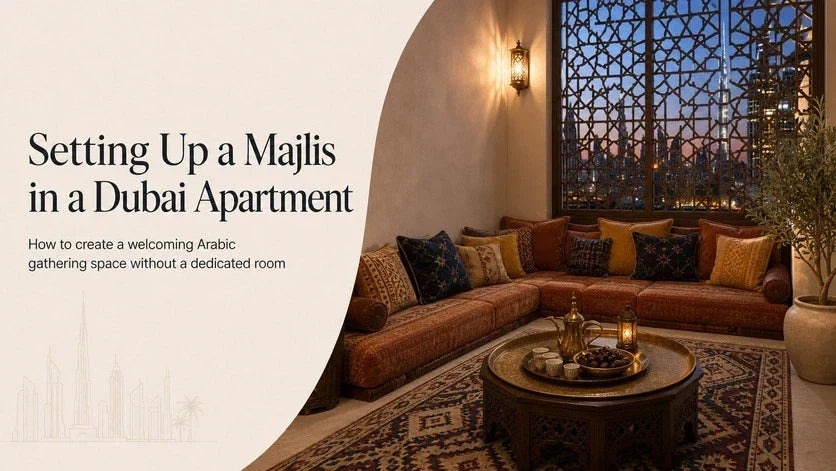
Guests arrive without much notice, the coffee goes on, and everyone needs somewhere comfortable to sit. In a villa, that happens in the majlis. In a two-bedroom apartment in JVC, Dubai Marina or Business Bay, it happens in the only living room you have — the one with the TV, the dining table and a landlord who would rather you did not drill the walls.
The good news is that a majlis was never really a room. It is a way of seating people. Once you understand which parts of that tradition are structural and which are just habit, you can build a proper majlis into a 20 m² living room without renovation, without losing your deposit, and without the space feeling like a waiting area for the rest of the week.
Here are the layouts, measurements, furniture and budgets that make it work.
What Actually Makes a Majlis a Majlis
Strip away the carved frames and gold detailing and a majlis comes down to five things: low seating, guests facing one another rather than a screen, enough capacity for a group arriving at once, a surface within arm's reach of every seat, and a sense that the space is set apart for hosting.
Three of those translate into an apartment almost perfectly. Two need adapting.
|
Feature |
Essential in an apartment? |
How to handle it |
|
Low seating, 38–45 cm seat height |
Yes |
Choose a low-profile sofa rather than a standard 50 cm one |
|
Guests facing each other |
Yes |
Seat along two walls in an L, not in a row facing the TV |
|
A surface near every seat |
Yes |
Nesting and folding side tables between seating runs |
|
Capacity for 10–20 guests |
Adapt |
Core seating for 6–8, expandable with poufs and floor cushions |
|
A separate reception room |
No |
Zone one corner of the living room instead |
The word majlis simply means a place of sitting. The tradition is about hospitality, not square metres, which is why an apartment version is not a compromise — just a different scale.
Know Your Space Before You Buy Anything

Most majlis advice online is written for 50–80 m² villa reception rooms. Dubai apartment living rooms are a different world, and the numbers matter.
|
Apartment type |
Typical living room |
Realistic seating run |
Guests seated |
|
Studio |
12–16 m² |
240–300 cm |
4–5 |
|
1-bedroom |
16–22 m² |
300–400 cm |
5–7 |
|
2-bedroom |
20–28 m² |
400–500 cm |
7–9 |
|
3-bedroom |
26–35 m² |
500–650 cm |
9–11 |
The maths behind that table is simple: allow roughly 60 cm of seating width per guest, and keep at least 80–90 cm of clear walkway between the seating and the centre table so people can pass without asking others to stand.
If your typical gathering is twelve people, do not try to buy twelve permanent seats. Buy seven or eight good ones and plan for the rest to appear from storage.
Four Layouts That Work Without a Majlis Room
The L-shaped run is the default and the one that suits most one and two-bedroom apartments. A modular or corner sofa hugs two walls, the centre table sits in the middle, and the open side faces the room. It gives you the wall-aligned seating of a traditional majlis with furniture that reads as completely contemporary.
The majlis corner works when the living room also has to be the family TV room. You dedicate one corner — ideally the one visible from the entrance — to a low two or three-seater, a rug section and a low side table, and keep the main sofa oriented towards the screen. Two zones, one room, no wall required.
The expandable majlis is the most practical option for anyone who hosts in bursts. The everyday setup is modest: one low sofa, an armchair, a rug. When guests arrive, storage ottomans open up, floor cushions come out, and the same corner seats twelve. Fifteen minutes later it is back to normal.
The living-dining loop suits open-plan apartments where the dining table sits in the same space. Instead of fighting that, you treat the evening as a sequence — coffee and dates in the seating zone, the meal at the table, then back to the seating for the long conversation. The furniture only needs to support the movement between the two.
Zoning Without Walls, and Without Losing Your Deposit
A majlis feels like a majlis because it is defined. In a rental apartment you define it with objects rather than construction.
The rug does most of the work. It should sit under the front legs of every piece of seating in the zone, which usually means 240 × 340 cm in a one-bedroom and 300 × 400 cm in a larger living room. A rug that floats in the middle of the floor, too small for the furniture around it, is the single most common reason an otherwise good setup looks unfinished.
Furniture can draw the rest of the line. A console behind the sofa back, a low shelving unit or the back of a modular section all mark where one zone ends and the next begins, at a height that does not block sightlines. For a stronger separation, a freestanding folding screen or a mashrabiya-style panel gives you the visual privacy of a wall while leaning against it rather than being fixed to it.
Lighting finishes the job. Switch off the ceiling light during gatherings and use a floor lamp plus one or two table lamps at around 2700K. Warm, low light pulls the seating zone forward and pushes the rest of the room into the background — the cheapest zoning tool you own.
Everything here is reversible, which matters when the tenancy ends.
Choosing the Furniture
Seat height is the specification that decides whether the room feels like a majlis or a lounge. Aim for 38–45 cm. Above 48 cm the posture becomes Western and the atmosphere changes; below 35 cm, older guests struggle to sit and rise comfortably.
Depth comes next. Villa majlis seating is shallow — around 60 cm — because guests sit upright rather than reclined, and in an apartment that shallowness also saves floor space. Resist the deep 90 cm lounging sofa.
Modularity matters more in a tower than in a villa, for a reason nobody mentions until delivery day: a one-piece sofa that will not fit the service lift is not a sofa, it is a problem. Modular sections and knock-down frames solve this, and they also come apart when you move apartments.
For the expandable layer, these are the pieces that earn their space:
-
Storage ottomans that seat one person and hold the cushions for four
-
Floor cushions in 60 × 60 cm or 70 × 70 cm, stacked in a corner or a basket between gatherings
-
Nesting or folding side tables that separate for a crowd and tuck away afterwards
-
A bench or trunk near the entrance, which doubles as guest shoe storage
One accent chair with a distinct silhouette is worth including if the floor plan allows. It breaks the symmetry of the seating run and gives the host or the eldest guest a natural seat of honour.
Fabrics, Colour and the Dubai Climate

Apartments in Dubai combine two things that are hard on upholstery: constant air conditioning and floor-to-ceiling glass. Performance velvet, high-grade microfibre and dense bouclé handle both well — they clean easily, they tolerate humidity swings, and they hold colour. Natural silk and untreated linen look beautiful for a season and then fade and absorb dust.
If your living room faces west or south, sheer curtains during the day are not decoration but protection. Deep jewel tones and dark neutrals fade fastest under direct Gulf sun.
For colour, earth tones do the heavy lifting — sand, warm terracotta, muted sage, soft brown — with one accent shade repeated in both the majlis corner and the rest of the room so the two read as one design rather than two. Cushion covers are the cheapest way to shift the mood seasonally, particularly before Ramadan and Eid, when the room works hardest.
Hosting in One Room
Coffee service is easier than it looks. A single tray station on a console or ottoman — dallah, finjan cups, dates, a thermos — saves you walking to the kitchen every few minutes and keeps the ritual visible, which is half the point.
Bakhoor needs slightly more care in a tower than in a villa. Use the mabkhara away from smoke detectors and near a window or the balcony door, and keep the burn short. In buildings with sensitive detectors, reed diffusers or an oud-based room spray give you the scent without the alarm.
Then there is the television. Traditionally a majlis has none, because the room exists for conversation. In an apartment you rarely have the luxury of a screen-free room, so the workable compromise is orientation: place the seating so the TV is off the main conversational axis rather than at the centre of it, and switch it off when guests arrive. The room changes character in seconds.
What It Costs in Dubai
|
Level |
Total (AED) |
What it covers |
|
Starter |
6,000 – 12,000 |
Low sofa or compact corner, rug, one side table, cushions |
|
Mid-range |
12,000 – 25,000 |
Modular corner, accent chair, larger rug, nesting tables, lighting |
|
Premium |
25,000 – 45,000+ |
Custom modular seating, hand-knotted rug, screen, full textile and decor layer |
If the budget is tight, spend it on the seating and the rug first — those two decide whether the space works. Tables, lighting and decor can follow over the next few months, and payment options such as Tabby and Tamara make staging the purchase easy.
Before You Order
Three checks prevent almost every delivery problem in a Dubai apartment. Measure the service lift, the lobby doors and any tight corridor turn, and compare them against the largest single piece in your order. Confirm with your building management whether a move-in permit or NOC is required and which hours deliveries are allowed. And take five minutes to plan where extra seating will live between gatherings — a majlis that has nowhere to store its own cushions quietly stops being used.
The mistakes worth avoiding are equally predictable: a sofa too deep for the room, a rug too small for the seating, mismatched seat heights between pieces, seating with its back to the entrance, and heavy carved furniture in a room that cannot carry the visual weight.
Frequently Asked Questions
Can you have a majlis in a Dubai apartment?
Yes. A majlis is defined by low, wall-aligned seating and hospitality, not by a dedicated room. A well-planned corner in a 20 m² living room can seat eight to twelve guests comfortably.
How much space does a majlis need?
Allow about 60 cm of seating width per guest plus an 80–90 cm walkway. A 20 m² living room supports roughly four to five metres of seating, which is seven to nine seated guests.
What is the right seat height for majlis seating?
Between 38 and 45 cm. This keeps the low, level posture that gives a majlis its atmosphere while still being easy for older guests to use.
Can I create a majlis in a rented apartment?
Yes, using only reversible elements — a large rug, a freestanding screen, a console behind the sofa and lamp-based lighting. None of it requires drilling or permanent changes.
Do I need floor seating for it to be authentic?
No. Floor cushions are a useful way to expand capacity for large gatherings, but low sofa seating meets the same spatial convention and suits daily apartment life better.
How much does a majlis setup cost in Dubai?
Between roughly AED 6,000 for a compact starter setup and AED 45,000 or more for a fully custom one, with most apartment projects landing in the AED 12,000–25,000 range.
Оставить комментарий
Этот веб-сайт защищается hCaptcha. Применяются Политика конфиденциальности и Условия использования hCaptcha.